
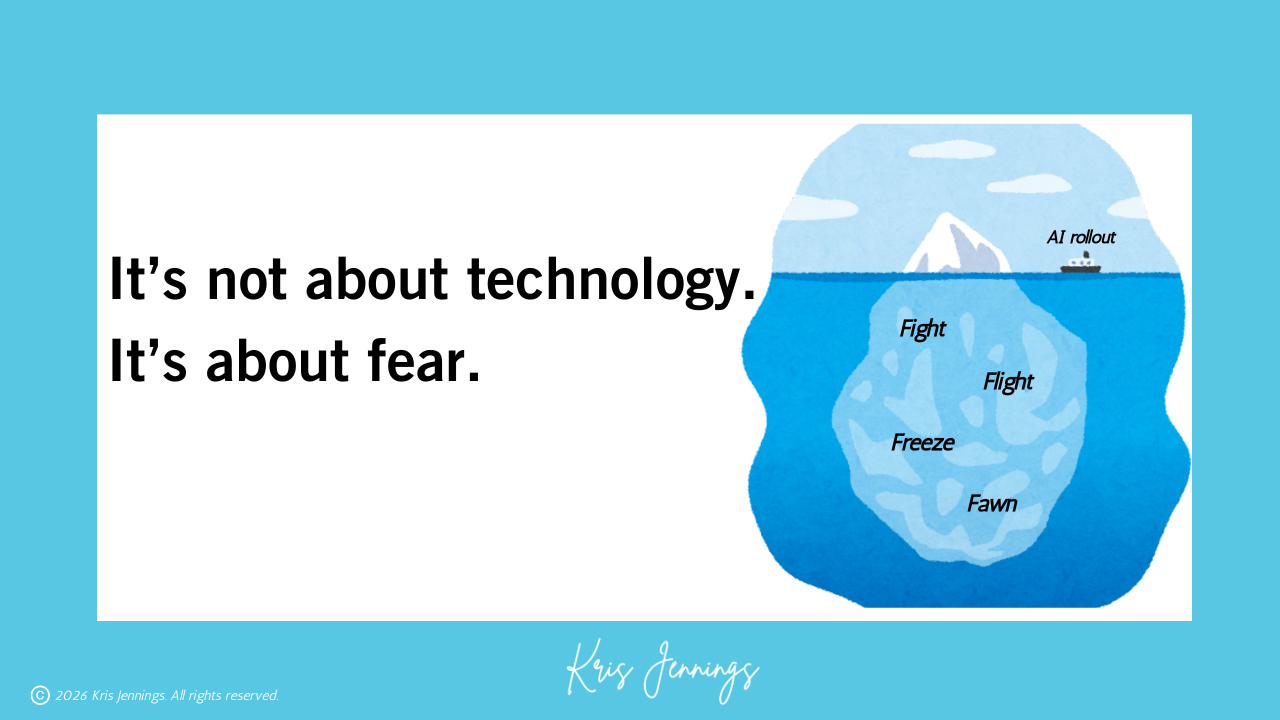
What fear looks like in your AI rollout
Jun 30, 2026"It's a people problem."
Most leaders with a stalled AI rollout describe it as a people problem. But they're not sure how to get beyond the high-level diagnosis to address the root cause.
The licenses are assigned. The training happened. The communications went out. The adoption data (if it exists) is not good = We have a people problem.
What's really going on with your people under the surface? It's fear, in all its forms and behaviors. BCG puts it bluntly: success in AI implementation is 70 percent people and ways of working, and only 30 percent technology.
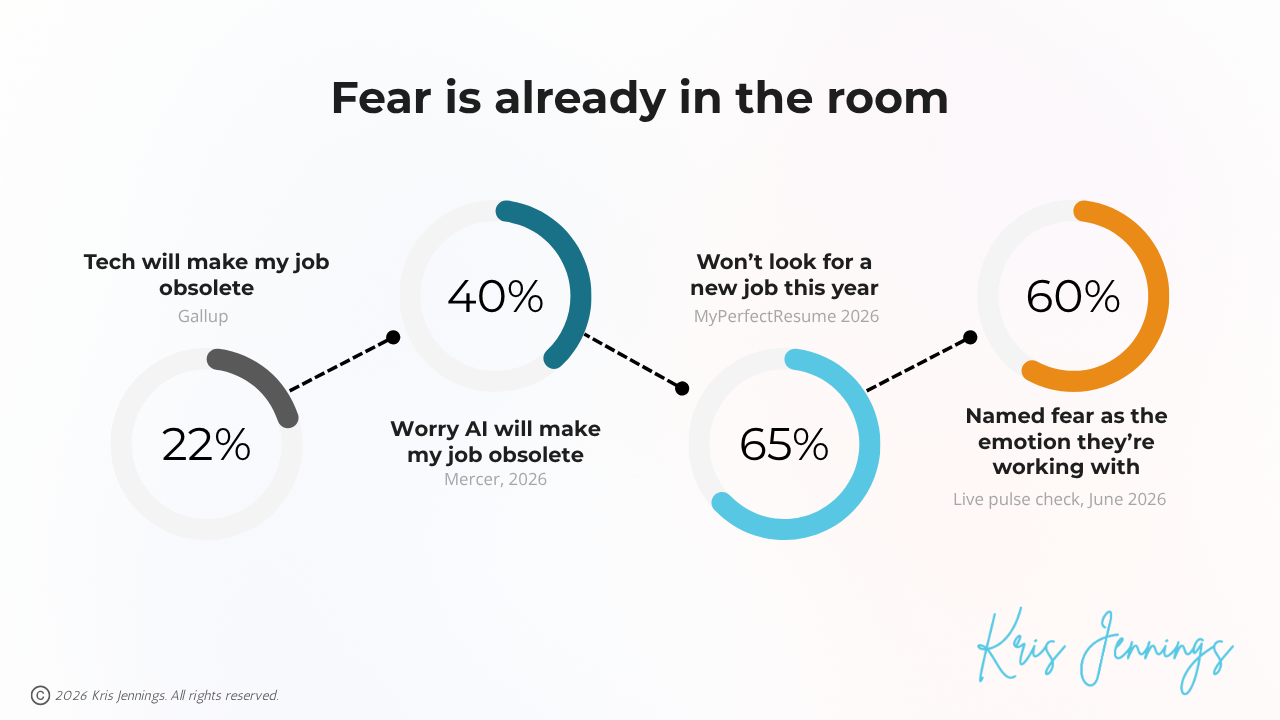
The data on how much fear is already in the room is worth a review:
- Gallup found that 22 percent of U.S. workers worry their job will become obsolete because of technology. This is up from 15 percent in 2021.
- Mercer's Global Talent Trends 2026 survey of 12,000 workers puts the AI-specific number even higher: 40 percent now fear AI will make their job obsolete, up from 28 percent just two years ago.
- MyPerfectResume's 2026 State of the Workforce Report found that 65 percent of workers say they will not look for a new job this year, and 32 percent say they are afraid of losing the one they have.
Those numbers may be conservative. In late June, I ran a live pulse check during a speaking session: 60 percent of participants said fear is the emotion they're currently working with at work. Published research shows the trends. A room full of people captures the emotion in the room. Right. Now.
It's safe to say that most of the people impacted by your AI rollout are feeling fear. Why does this matter? Because emotions influence actions, and fear shows up in a variety of behaviors. You'll see it in meetings, in usage data, in decision-making. Sometimes the irrationality is obvious and helps clue you in to fear's presence. Other times, it can look like something else entirely.
Learning to recognize the behavioral responses to fear and the predictable ways it's showing up in organizations related to AI can improve your rollout and adoption strategy. If you're a leader responsible for increasing operational efficiency, automating processes or streamlining workflows, and you plan on using AI to do that, you need to understand the human reactions that will prevent you from being successful.
Fear produces four predictable behavioral responses: fight, flight, freeze, and fawn. These aren't personality types or failure modes. They're hardwired human protective responses, complete with physiological impacts and socially conditioned norms. They show up in our personal lives, but at work, they can be trickier to spot.
I've written about how the 4Fs appear in broader change contexts. What follows is what they look like, specifically when AI is the change. Once you know what each response looks like, you can stop diagnosing the symptom and start responding to what's driving it.
Fight: People lose trust in the AI's answers
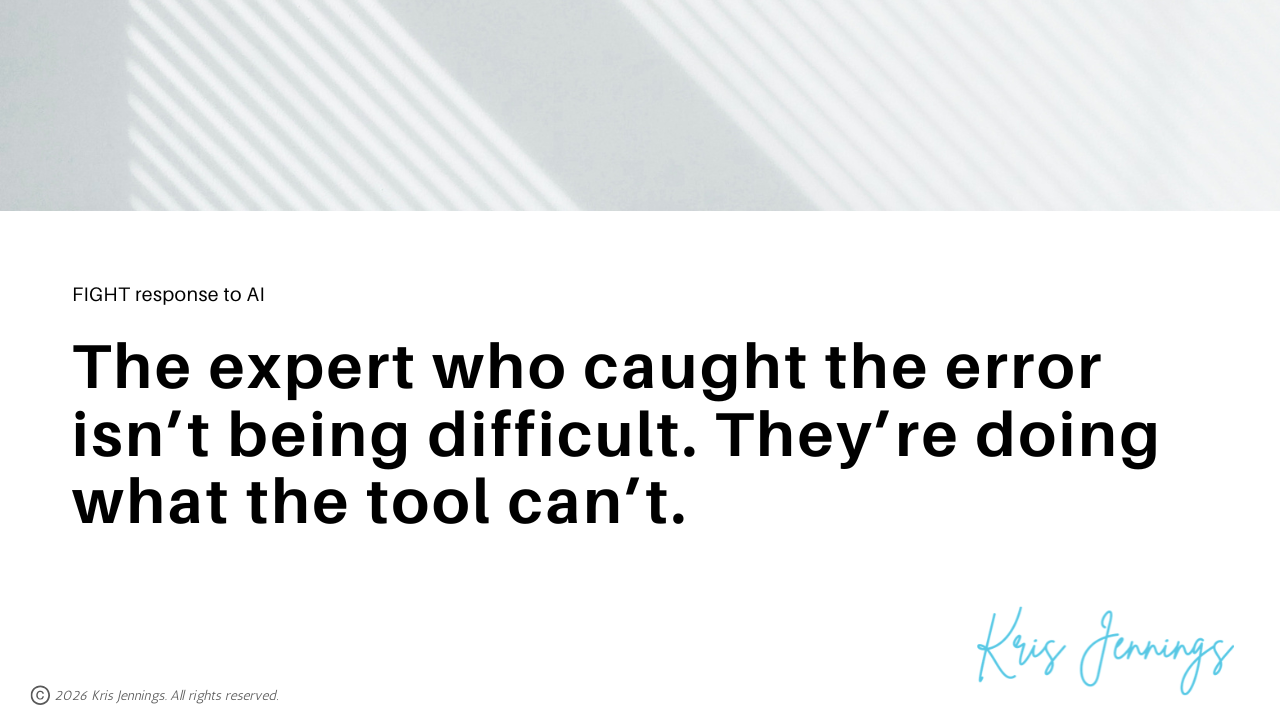
Fight isn't about people being difficult. It's about people protecting themselves from something that has, or could, make them look bad.
In an AI rollout, fight shows up as:
- Vocal skepticism in meetings, usually framed as accuracy or quality concerns
- Refusal to use the tool after a visible mistake, with that refusal communicated to peers
- Skepticism that spreads. One leader's bad experience becomes a team's informal (non-use) policy
- Managers who undermine a rollout by limiting their team's access without a clear reason why
The story underneath fight is almost always an identity threat. Knowledge workers have built their professional value on deep expertise. They are the humans with judgment, the pattern recognition, the knowing-when-the-common-answer-is-wrong that took years to develop. AI doesn't just ask them to learn a new tool. It asks them to work alongside something that appears to do what they do. That's not a training problem. That's a very real and very personal threat.
When the tool produces a visible error, that threat becomes concrete. The implied promise of the technology was credibility and accuracy (fast). When it fails publicly, the knowledge worker's skepticism is confirmed.
One example of AI use that I've experienced directly, and I hear it from peers who challenge the efficacy of AI, relates to AI credibility and accuracy. Ask AI for a specific reference or data point, and it returns something that looks authoritative. But as a human expert, you happen to know the attribution is wrong. Not approximately wrong. Wrong.
Now you have a choice: do you trust the rest of it? Which parts? That moment of catching the error doesn't just slow you down. It changes your relationship with the tool. Every subsequent output requires a discernment tax. Extra cognitive work of deciding what to verify, what to act on, and what to set aside.
There's a reason this reaction runs so deep, and it goes beyond loss aversion. The term "artificial intelligence" implies something invented or fabricated by a non-human. But what these tools actually do is pattern recognition across broadly available documented human intelligence.
I love the way artist and AI researcher Holly Herndon describes large language models (LLMs). She calls it collective intelligence: the common answer, synthesized and predicted from what sources say.
Getting that type of answer quickly is useful when common knowledge is good enough. It becomes a liability when your work requires deep expertise. The kind that knows when the common answer is wrong.
Knowledge workers who catch AI errors aren't being obstructionist when they fight AI usage. They're doing exactly what the technology can't do: applying domain expertise to evaluate whether the common answer is the right one.
The trust break is hard to repair. Loss aversion registers that mistake as roughly twice as strongly as an equivalent success. A single high-stakes error can override months of neutral or positive experience. And the knowledge worker who is protecting their sense of identity (the deep expertise that helped them succeed in the organization) is going to fight back.
The person who refuses to use the tool isn't being unreasonable. They're being human. They're protecting their hard-won expertise and their identity. Those are things worth fighting for and protecting.
What you can do about fight
On the back end of an AI-based error, what's needed is reputational repair. Fight, as direct resistance to AI adoption, requires a direct response. This is where the role of a change leader becomes more visible.
A human owner needs to recognize that the error happened and understand what caused it. This looks like a thorough review of what went wrong and what's different now, whether that's adding a process step for human review of key outputs or more narrowly defined prompts to manage risks more effectively.
On the proactive side, fight asks organizations to make sure they have a human leader overseeing the rollout, and that change leader is prepared to continue learning and refining AI usage, including sharing the missteps and repairs with stakeholders so that there's continuous improvement.
This change leader can also anticipate where threats to identity will prevent adoption with particular stakeholders, such as knowledge workers, and how those humans interact with the AI to discern it's outputs to manage organizational risk.
Fight as a resistance to AI softens when trust is rebuilt through transparency. Reduce a fight response by anticipating threats to identity.
Flight: Ghost features
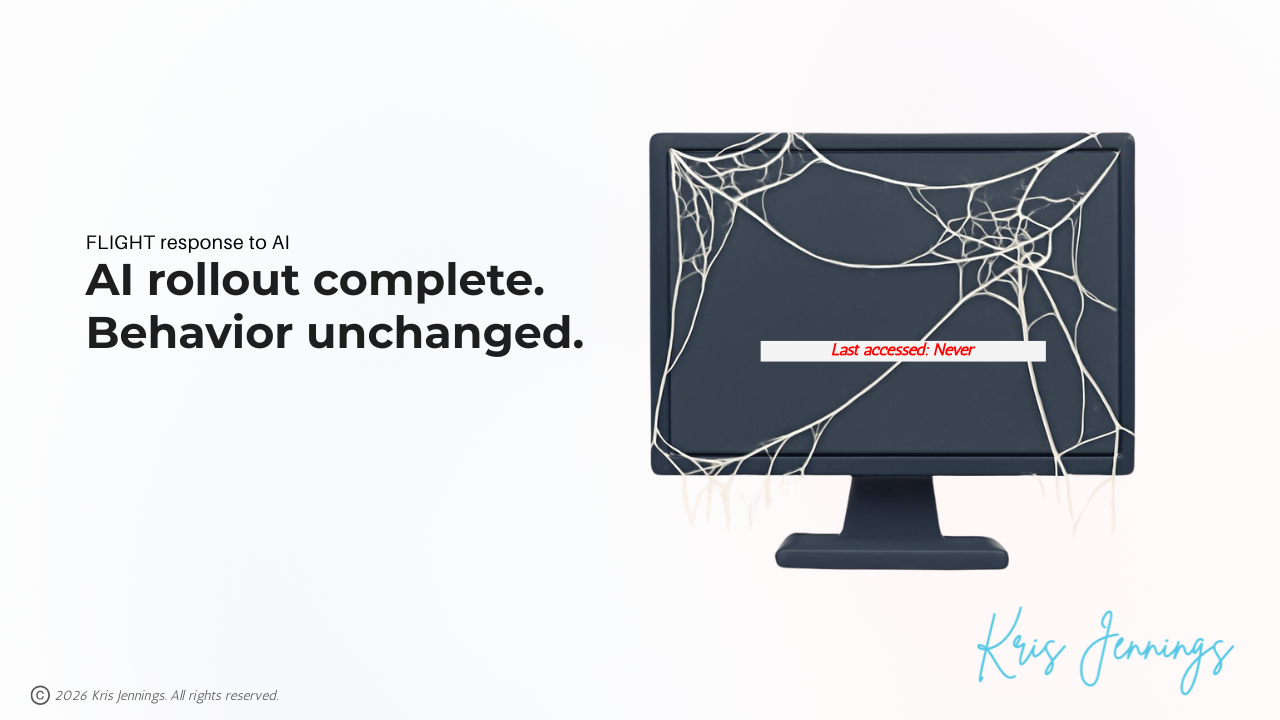
Flight in an AI rollout is organizational before it's individual. It's what happens when a tool is deployed without a behavioral goal and without any mechanism for knowing whether people are using it.
In essence, no one is minding the store.
It looks like this:
- Licenses are active, but no one is monitoring data
- "Rollout complete" means the tool is available and training has happened, not that behavior has changed
- There's no defined workflow that the tool was supposed to improve, and no measure of whether it has
- The rollout appears in a project completion report and disappears from the leadership agenda
Let's use a common example from enterprise-size organizations. Rather than rolling out a proprietary standalone AI product first, many choose to implement embedded AI features from their existing software suite. It's a safe bet and makes sense as a way to lead people gradually into AI usage.
Workday's Manager Insights Hub is one example. It's a dashboard feature that surfaces real-time analytics about team performance and workflow patterns. For busy managers, this dashboard is a genuinely useful capability. Organizations can choose to make it the default landing page for roles or let individual managers choose it as their home page.
But the AI rollout misstep I'm seeing organizations make with features like this is that there isn't an intentional focus on the behaviors users need to adopt the change. The availability gets communicated, and maybe a training session is offered on how to configure the dashboard as your preferred home page, but six months later, the feature is a ghost in the background. Not because managers are avoiding it. Because the default choice the organization made to make the dashboard an optional selection didn't drive the new behavior.
That's flight. The fear isn't always conscious. Sometimes that fear belongs to you as the decision-maker — the one who chooses the safer rollout option because it requires fewer approvals and less noise from stakeholders.
In an environment where AI carries real implications for job security and future value, people don't decide not to engage. They just engage less visibly.
Invisible non-adoption is the easiest kind to mistake for success.
What you can do about flight
Flight needs a clear behavioral goal and visibility into what behavior is changing. What does using this tool look like on a Tuesday for this role? Until that question has a specific, observable answer, flight is the default outcome.
Someone also needs to own the data. Flight stays invisible when no one is accountable for watching whether behavior is actually changing. That means a named person reviewing usage patterns, asking 'why aren't people doing ____ with this,' and being empowered to adjust the rollout based on what they find.
Invisible non-adoption doesn't fix itself.
Post 1 in this series walks through exactly how to define that goal.
Freeze: When both options feel risky
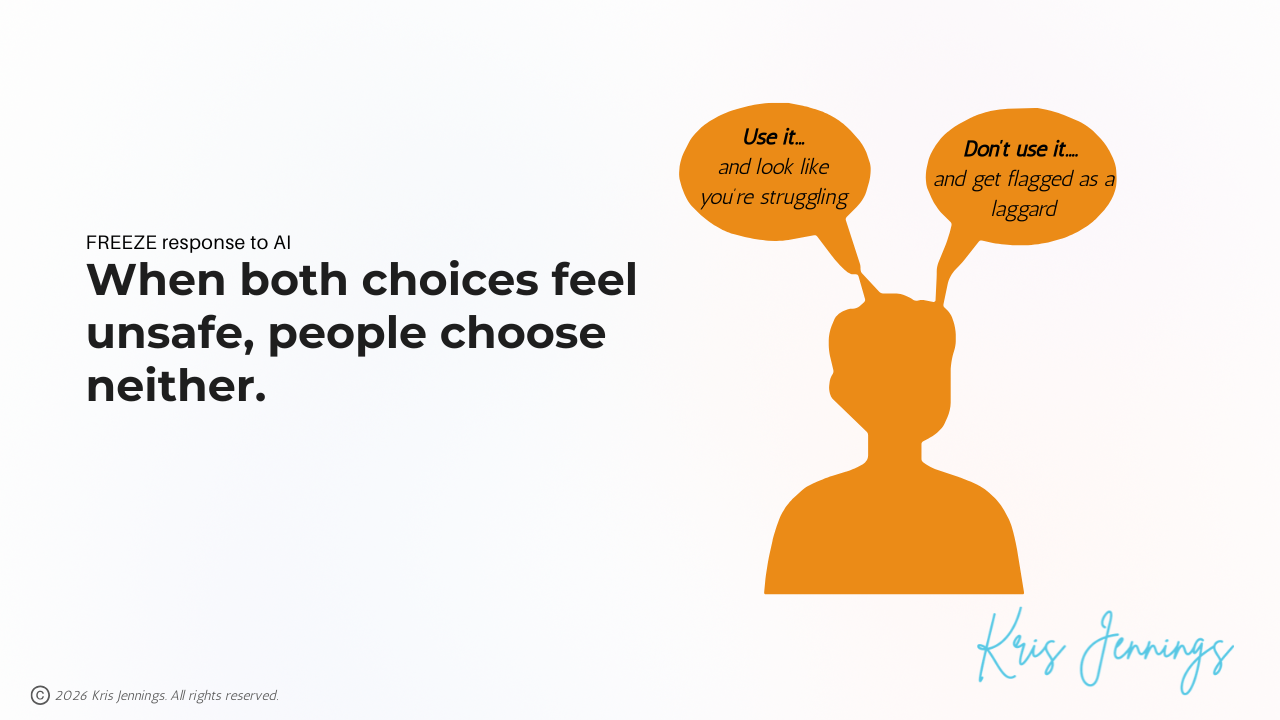
Freeze is what happens when an employee has access to and understands the tool, but holds back because acting in either direction feels risky.
The MyPerfectResume data cited earlier is insight into what a freeze response looks like. Sixty-five percent of workers say they won't look for a new job this year. Thirty-two percent are afraid of losing the one they have. That's not a population primed for visible experimentation. That's people who are actively avoiding more risk.
AI adoption requires taking a behavioral risk that may feel like one risk too many when your primary goal is keeping what you have.
In an AI rollout, freeze looks like:
- Employees who attended training and have licenses but rarely open the tool because they're waiting to be told what to do.
- Tentative or inconsistent use, failure to build habits around specific behaviors or use cases. Trying it once or twice, then stopping
- Reluctance to use AI features in contexts where the output will be visible to others, especially leadership
- Employees asking each other quietly what leadership is tracking, but not asking leadership directly
For users, a freeze response usually means they believe they're in a lose-lose situation. Using the tool and producing a subpar output slowly while the skill is new signals something about your capabilities. Not using it and getting flagged as a "resistor" signals something else.
Neither option feels safe.
So people do nothing. They freeze. The Great Stay isn't just a labor market phenomenon. Inside your AI rollout, it looks like flat adoption data from employees who are present, compliant, and completely still.
This is fear showing up as a behavioral signal, not as a communication or training gap, and it requires a fundamentally different leadership response than more information.
What you can do about freeze
Freeze requires direct reassurance, clear and ongoing communication about what is and isn't being tracked, and gentle nudges into action that feel like safe "risks".
The freeze thaws when the stakes feel lower. You lower the stakes by naming them explicitly, recognizing that silence does not mean safe.
In practice, this looks like a leader saying in a team meeting: 'I want to call out one thing specifically: No one is tracking your individual usage to evaluate your performance. Here's what we are measuring and why.' This happens in team conversations, 1-1 discussions, more than once.
Gentle nudges look like low-stakes invitations rather than requirements: a team trying one AI-assisted task together, a leader sharing what they attempted (not what they perfected), a clear first use case small enough that success is a virtual guarantee.
The goal is to make the first visible action feel survivable. Once people have one positive experience they choose to do, the freeze begins to thaw.
Fawn: The performance of adoption
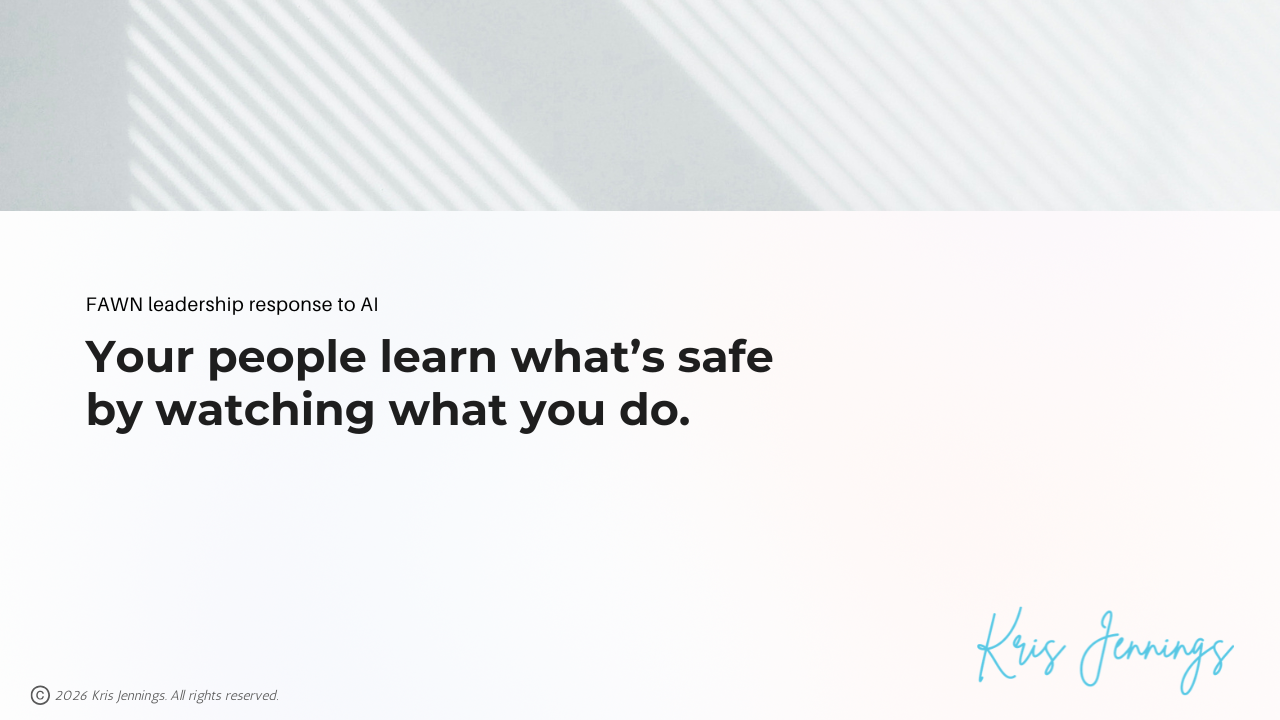
Fawn is the most seductive fear response in an AI rollout because it looks like progress.
It shows up in two forms, and both are worth knowing.
The first is the vocabulary performance. People talk about AI in meetings. They share articles. They reference it in strategy conversations. There is a lot of thinking about AI, discussing AI, and planning to use AI. Workflows have not changed. In organizations right now, there's significant social pressure to appear current on AI.
Being seen as someone who "gets it" carries status. So people perform the posture of adoption. The vocabulary, the apparent curiosity, the visible engagement, without taking the behavioral risk of changing how they work.
The second is the metrics performance. In organizations where AI usage is tracked and dashboards are visible to leadership, some employees learn to work the data. They open the tool. They run queries. They log activity. The usage reports look healthy. The work coming out of those employees looks the same as it did before.
The fear here isn't about being seen as a laggard. It's the competency threat of being seen as struggling. Gaming the metrics is lower-risk than using the tool imperfectly in a visible way.
Both forms share the same root: fear showing up as performance rather than change.
Fawn looks like:
- High participation in AI discussions; low actual usage
- Leaders who speak fluently about AI strategy but haven't personally changed a workflow
- "AI champions" who are articulate about the tool's potential but can't point to a specific task they do differently
- Usage data that looks like adoption but doesn't correspond to any change in output quality or speed
The fear underneath fawn is about the social risk of trying something in front of peers and not doing it well. In organizations without psychological safety around experimentation, performing adoption is safer than attempting it. Performing costs nothing. Actually changing how you work, and having that change be visible and imperfect, costs something real.
What you can do about fawn
In organizations where leaders model imperfect experimentation publicly, it becomes safer to try and not perfectly succeed. This looks more like informal demonstrations rather than polished ones where leaders share what they tried and what didn't work, and how they're adjusting to try something else next.
When leaders perform competence around AI, they reinforce the performance in everyone else. When they model learning, they make it safe to try. This is the behavioral dimension of what it means to walk the talk during change and it matters more in an AI rollout than in almost any other context, because the stakes feel incredibly high when people are afraid.
Which one are you looking at?
Most organizations in the middle of an AI rollout are seeing more than one of these — often all four. Fight in one function, flight where no one defined what adoption was supposed to look like, freeze in the employees managing risk in every direction while staying in a job they've outgrown, fawn at the leadership level where the stakes feel highest, and the performance pressure is loudest.
Pay attention to that last one. Leaders aren't exempt from fear in a change implementation. The same force that makes an employee game a usage dashboard makes a leader choose the safer rollout option. The same identity threat that makes a knowledge worker fight AI accuracy makes an executive perform fluency they don't yet have. Fear doesn't stop at the org chart.
This matters because the diagnostic work this article is asking you to do — recognizing which response is dominant in your people and matching your response to what's actually driving it — requires that you can see fear clearly. In your organization. In your stakeholders. And in yourself.
Remember: 60 percent of the people listening to me speak about emotions said fear is the one they're currently working with. That's not a fringe response. That's the dominant experience of the workforce navigating your rollout right now.
That starts with noticing and naming it. Not managing it away, not routing around it by sending another memo or holding another round of training, but recognizing it for what it is: a predictable human response to a change that feels genuinely threatening. When leaders can do that — when they can name what's happening in a room, in a data set, in a one-on-one — they create the conditions for behavior to actually shift. That's what human-to-human leadership looks like in an AI rollout.
More training doesn't help a freeze response. Better communications cadence doesn't address fawn. What moves people is being seen accurately and responded to honestly.
That's the work. AI can't do it for you.
Bring strategies to reduce fear to your organization
Book a keynote for your employees on the Emotions of Change to help them learn how to notice and name the fear and shift themselves out of it →
Learn more about practicing and applying these fear reduction strategies if you're leading an AI rollout by enrolling in the fall cohort of The changecapable Leadership Program →
Related reading: The 4Fs in organizational change | The big 4 emotions of the change curve | 5 ways leaders make change harder | Walk the talk: trust signals that make or break change | Post 1: Why your employees aren't using your AI tools
The behavioral science behind this post is drawn from 30 years of leading organizational change and four national digital product launches. It's the foundation of the changecapable method and shared in my book, Inspired by Fear: Becoming a Courageous Change Leader.
