
You can't outsource change leadership
Oct 14, 2026Last month I was in a room with a group of senior leaders. They peppered me with questions about how to move their people forward faster during a major organizational transformation. They thought it was stalling the business. They were, rightfully, frustrated because they were putting a lot of effort into supporting their people.
Partway through, I watched something land. You could feel the shift.
The realization was this: Pushing harder wasn't working. The resistance wasn't truly about the task at hand; it was about the way the people felt about it. For all of the effort the team had put into getting the activities in the plan right, they'd failed at dedicating enough time to the humans in the experience.
That moment is common in organizations going through significant change. Getting a great list of activities into a project plan has been the predominant way of supporting change for almost three decades now. Yet, the world has changed. It's time for change to change, too.
Change management is not change leadership
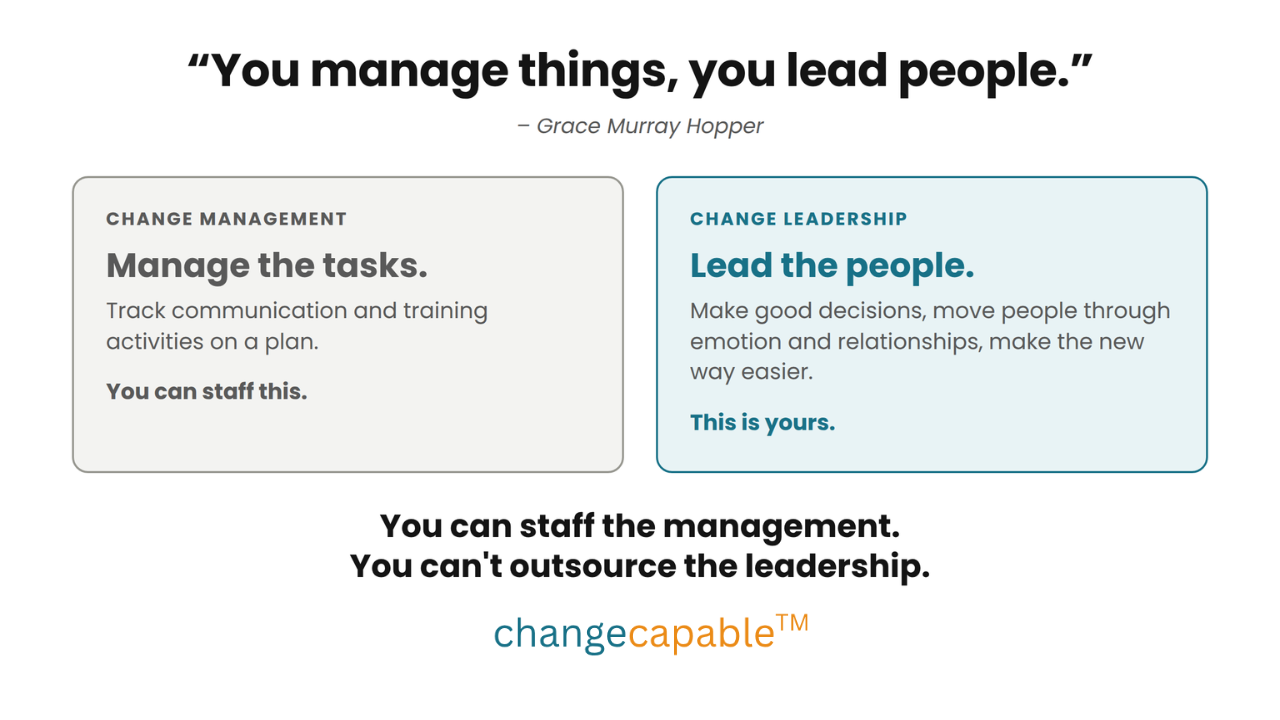
I love this line from Grace Hopper, the pioneering computer scientist and Navy rear admiral, "You manage things, you lead people," she said. "We went overboard on management and forgot about leadership."
She could have been describing change work today.
Change management is the work of managing the tasks a change requires. Plans, activities, communications, training, readiness checks, stakeholder maps. It is real, skilled work, and it can be staffed.
Change leadership is the work of leading the people through the change. Naming why it matters, modeling the behavior you are asking for, influencing people who are afraid or unconvinced, staying present through the fearful uncertainty. It is also real work, but it cannot be staffed the same way, because it relies on the trust and the relationships of the person doing it.
Change management has been codified into a profession, with standards, certifications, and defined roles. The skills of leading change have been studied, but never built out the same way. Leaders are told to ‘be a good change leader’ often without a clear path to get there, and most models still name only a sponsor and a manager.
We also rarely tell leaders how strong those skills need to be, based on their role in the change and how big and complex the change is.
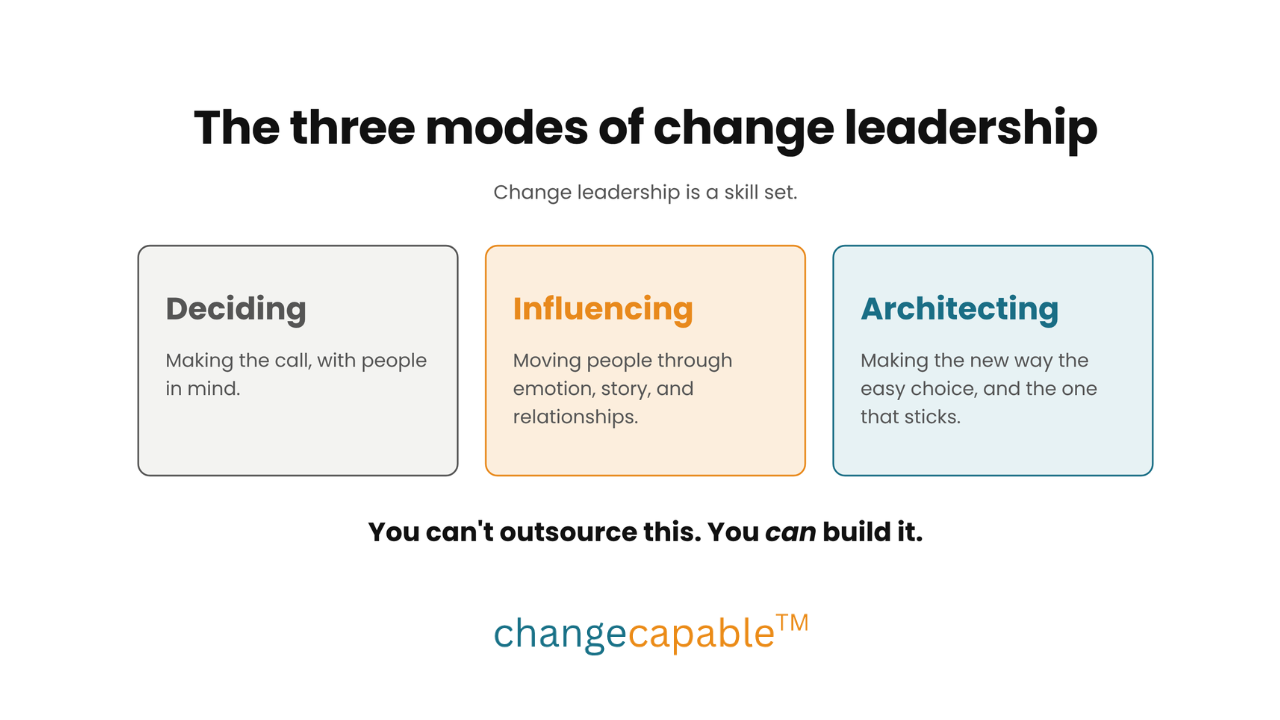
The changecapableTM method closes that gap by developing change leaders using three modes:
- Deciding: making the call, with people in mind.
- Influencing: moving people through emotion, story, and relationships.
- Architecting: making the new way the easy choice, and the one that sticks.
All three modes can be learned. They're also not limited to positional authority, but cultivated in a variety of roles that steer, shape, spread, and facilitate change.
Change leadership is not a personality trait. It's a set of skills that can be developed on the job and grown over time as the complexity of change efforts increases.
There is one more layer, and it is the one that takes time to build. Maturity in change leadership is knowing which mode a moment calls for. Early on, a leader reaches for whichever mode feels most natural. With practice, leaders learn to read the room and pick the one the situation needs: the decision, the emotion, or the adaptable structure.
Knowing which mode, and when, is what separates someone who knows the model from someone who leads with it. In this article, I go deeper into how the three modes develop and the research testing them.
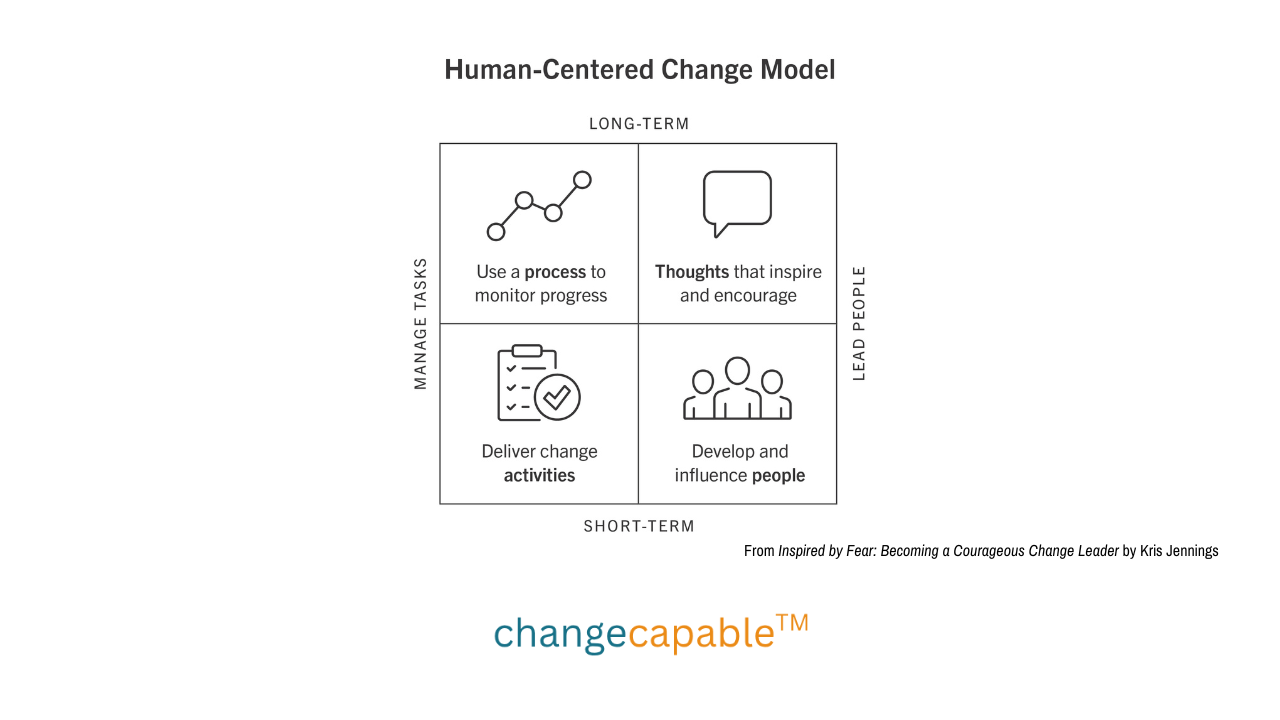
I first wrote about the differences between change management and change leadership in my book Inspired by Fear. In it, I shared my Human-Centered Change Model, which visualizes the distinctions.
One side manages the tasks: deliver the change activities, use a process to monitor progress. The other leads the people: develop and influence them, offer the thoughts that inspire and encourage.
The vehicle most organizations use today to track the activities of implementation progress, a project plan, lives entirely on the manage-tasks side. Adoption lives on the lead-people side.
That is why more tasks never fix a people problem. You are pouring effort into the wrong side of the model.
Activity is not adoption
The traditional change management process, the one you rent, is busy. It produces plans, decks, comms calendars, readiness dashboards. All of that is motion, and motion feels like progress. But activity is not adoption. Lasting change is built on the choices people make, and people don’t choose in the way a project plan assumes.
Four places this shows up:
- The process treats the change as already decided. Once leaders sign off, the plan assumes people will follow: announce it, train it, track it. But every person still makes a choice, and often more than one. Whether to try the new way. Whether to stick with it when it’s slower at first. Whether to quietly slip back to the old one. If no one designs for those choices, they’re left to chance. Or even worse, the change feels like a "have to do" because the choice has been made for people.
- The process assumes that once people know, they’ll do. Explain why, train how, go live. But knowing and doing are far apart. Most people fully intend to use the new way and still fall back on an existing habit when the moment comes. Behavior changes when the new way is built into that moment, with a clear cue, a default that points the right way, and a plan for when and where.
- The process tries to manufacture desire. It sells the upside, louder and more often, and calls that buy-in. But people are not stuck because they missed the message. They are losing something, and they are afraid of what the change will cost them. You do not argue someone out of a loss. You meet them in it so that it feels authentic and transparent. That builds trust for this change, and the next one.
- The process reinforces with recognition. A program, an award, a mention at the town hall. Recognition is nice. It is not how habits form. People look to each other to see what’s normal, and they move when they see people like them already doing it. New behavior sticks when the new way is easier than the old one, when it’s visible in the people around you, and when you catch people doing it right close to the moment they do it.
So the traditional approach creates a great deal of activity and not much adoption. Everyone is busy, and nothing moves.
Why it matters now
This matters more now than it did two years ago.
The task side of change is the part a machine can do. AI can draft the communications, build the training, fill in the plan, watch the readiness numbers. The tactics are being automated, and fast.
What AI cannot do is be the leader. It cannot mean it. It cannot model the behavior or catch someone in the moment trying the new way and celebrating it. It cannot sit with someone in their fear and stay. A live human leader in the room is the one part of change that does not automate.
As the management gets cheaper and faster, the leadership matters more than ever. It’s always been the part that moves people.
Change gets implemented, but adoption fails
Here is the part that makes me cringe.
A leader senses the people side is going badly. Resistance is rising, behavior is not shifting. So they bring in an organizational change management (OCM) practitioner, hand over "the change piece," and consider it covered.
It is not covered. It has been misdiagnosed.
A skilled practitioner can run the mechanics well. Build the plan, sequence the communications, stand up the training, track readiness. What they cannot do is be the leader. They cannot supply the belief that only lands when the person with authority means it. They cannot model the behavior for someone else or encourage the first attempts. They cannot carry a relationship they do not have.
People recognize the difference immediately. They know they're being "change managed" rather than authentically led. They can tell the difference between a leader who is in it and a communications plan produced by someone standing in for one.
Behavior changes in response to leaders, not to a deliverable. Handing off the leadership is not delegating a task. It is leaving the responsibility unfilled.
This is the exact trap Hopper named. We go overboard on the management and forget the leadership, then wonder why the people did not move.
Change leadership is not positional
There is a second version of the same mistake, and it hides behind the org chart.
Leaders sometimes assume the people work takes care of itself because they hold the title. It does not. Change leadership is a skill, not a position. I have watched senior executives with all the authority fail to move a single behavior, and I have watched program leaders with no direct reports influence an entire organization.
That second case matters more than we admit. Most transformation is run by someone with only temporary decision rights, where everyone on the team reports to someone else. That leader cannot fall back on hierarchy. What they have is the skill set itself: deciding, influencing, architecting. When those modes are strong, and the leader fluidly moves between them, the change moves. When they are missing, no amount of borrowed authority saves it.
This is where my work is headed. I believe a leader's skill on the people side of change is the largest single lever on whether a change is adopted. I am running a multiyear research effort to understand that link and how much of it can be taught. My working conviction is that most of it can. Not only that, if we do a better job of how the parts all fit together, it can get easier to do, too.
I'm already noticing how leading change isn't one person's job. Most changes run on several roles: a sponsor who decides, people who shape what changes, and people who carry it to their peers. Each role requires a different blend of the three modes.
What the change leader owns
None of this means leaders do the practitioner's job. The two are partners. The practitioner runs the machinery. The leader does what only they can do.
Learn to make good decisions, and help others make them too. Respond to the human emotions present in the change rather than setting it back by reacting. Telling a believable story themselves. Making it easier and stickier through structures. Name the why, in their own words, more often than feels necessary.
Model the new behavior in plain sight. Showcase the people who are already doing it. Have the direct, specific conversations with the people who are stuck. Reward the behavior you want, close to the moment it happens. Stay visible through the messy middle instead of reappearing at go-live.
That is the work that reduces resistance and moves people toward adoption. It is not more effort on the task side. It is the right effort on the people side.
Back to the conversation with the frustrated room of leaders. They left the conversation with more clarity about where to spend their limited time: In conversations influencing and listening, rather than adding more tasks to the project plan. They left lighter, because they finally saw what people need. The fix wasn't another task. It was them.
Common questions
Is change leadership the same as change management?
No. Change management runs the tasks and can be staffed. Change leadership leads the people and cannot be delegated. Most efforts fund the first and skip the second.
Can a project manager or change practitioner handle change leadership? They can run the mechanics of change management. They cannot be the leader. Belief, modeling, and relationship only carry weight when they come from the person with authority, whether that's temporary or positional.
Do you need formal authority to lead change?
No. Change leadership is a skill, not a position. A program leader with only temporary decision rights still needs the three modes: deciding, influencing, and architecting, and often leans on them more than a senior executive does.
Is a change sponsor the same as a change leader?
No. Sponsorship is a role. The sponsor is the executive who funds the change, owns the business case, and clears the barriers. That is mostly the deciding mode in action. Change leadership is a broader set of skills, and it applies to anyone who has to move people. It adds influencing, the social and emotional work of moving people who are afraid or unconvinced, and architecting, making the new way the easy choice and stickier. A sponsor can be a strong change leader, but the title doesn’t make them one. Nor does it mean that the work of leading the change is done by a singular individual.
If we have a strong executive sponsor, do we still need change leadership from anyone else?
Yes. A sponsor can’t reach every team or have every hard conversation. The managers and team leaders who carry the change to others need to influence. Whoever designed the new process or system needs to make it easy to adopt. The sponsor sets the direction. Change leadership at every level turns it into behavior. In a cohesive system with clear roles and responsibilities, the change leadership gets easier and stickier, too.
Related reading:
