
The Influence Stack: How change leadership actually develops and where most leaders get stuck
May 11, 2026Organizational change is not immune to change, and right now, the professional is experiencing significant disruption as AI automates the delivery of organizational change management activities.
There's no longer the need for large teams of people to draft stakeholder communications, synthesize progress updates, update progress dashboards, or produce training materials. The tasks that once justified large change management teams and weeks of senior leader preparation are increasingly handled within minutes using AI.
For most HR, Talent, and L&D leaders, this creates a question worth sitting with: What exactly is AI automating, and what activities need to remain uniquely human-led?
AI is automating the logistics layer of change management: information production and delivery. These activities are about managing the work, not leading people. Drafting, developing, and delivering communications, governance updates, creating training calendars, and producing stakeholder updates. Traditional OCM has built an entire discipline around this layer, and it served a valuable purpose to bring more discipline into the people side of projects.
But here's what three decades of watching change initiatives succeed and fail has taught me: that layer is not what moves people. It never was.
The organizations struggling with the big shifts happening in the world, including AI adoption, digital transformation, and restructuring, are the ones who are doubling down on the old way.
They're working harder at the logistics layer (or focusing on squeezing costs out of it in order to do more), hoping that better communication will eventually produce behavior change. It won't. Not because they aren't communicating well. Because the logistics layer was never the engine of adoption.
Traditional change management's ceiling is where real change leadership begins.
I've spent three decades watching leaders reach for more information when change stalls. More data. A clearer business case. Another slide deck explaining why this is the right direction. When that doesn't work, they do it again, louder.
It rarely works. Not because the information is wrong. Because behavior change was never a knowledge problem. Now that AI has taken the logistics work off the table, that truth is impossible to ignore.
Why the logistics layer isn't enough: The Informing layer moves beyond traditional OCM
Behavioral science has been telling us this for decades. People don't behave rationally. They don't weigh options objectively and choose the best one. They anchor to the familiar, overweight potential losses, follow what their peers are doing, and make decisions based on how choices are framed and sequenced.
A leader who relies exclusively on logic and information to move people is using the right tool for the wrong problem. In an environment where AI generates more information faster than any human team could, that approach is not just insufficient. It's losing ground. The volume of information people receive is going up. Their capacity to act on it is going down.
Cognitive overload is a problem in virtually every organization. Decision quality erodes when brains are tired, and motivation is depleted.
Most leaders know this at some level. They've felt the frustration of a message that landed perfectly in the all-hands and then watched with frustration as nothing changed. They've watched a compelling pilot program fail to scale. They've built a business case that everyone nodded at....and then nothing happened.
What they're missing isn't better information. It's a different mode of leading entirely. One that AI cannot replicate.
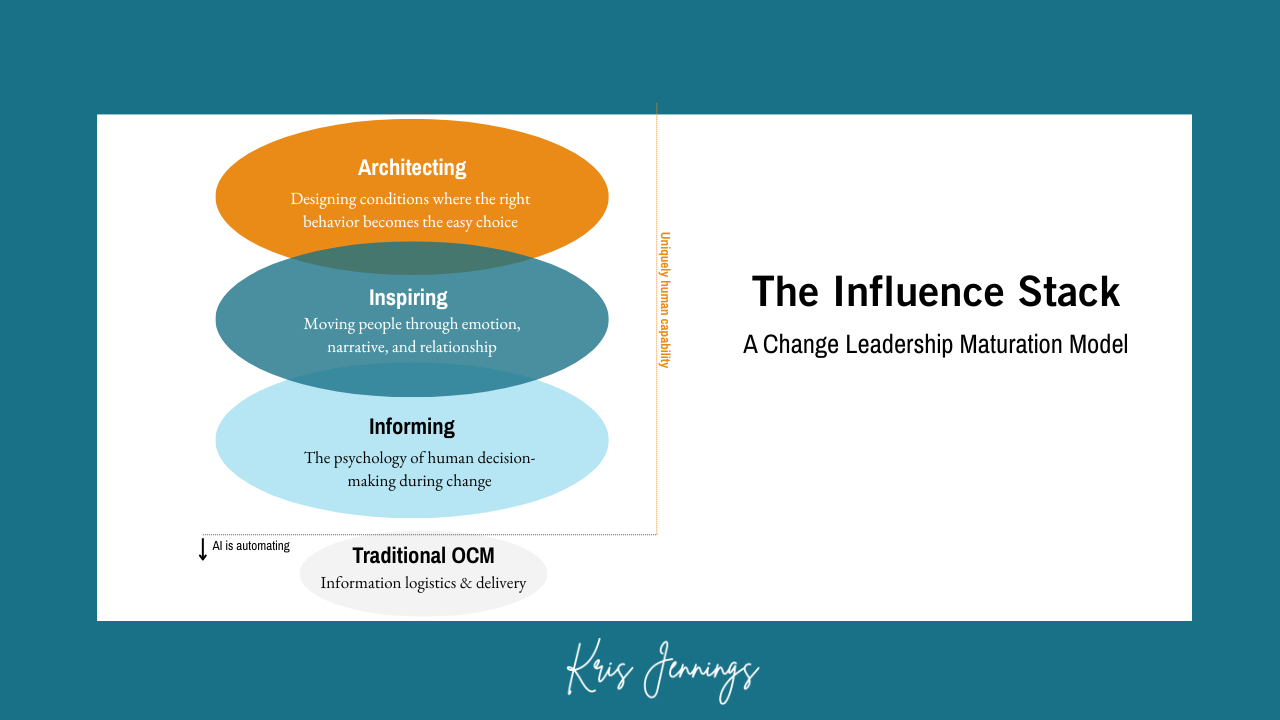
The Influence Stack
Over the course of my work advising leaders through digital transformations, product launches, culture shifts, and restructurings, and through the development of my changecapable™ method, I've come to see change leadership capability as a developmental arc. I call it the Influence Stack.
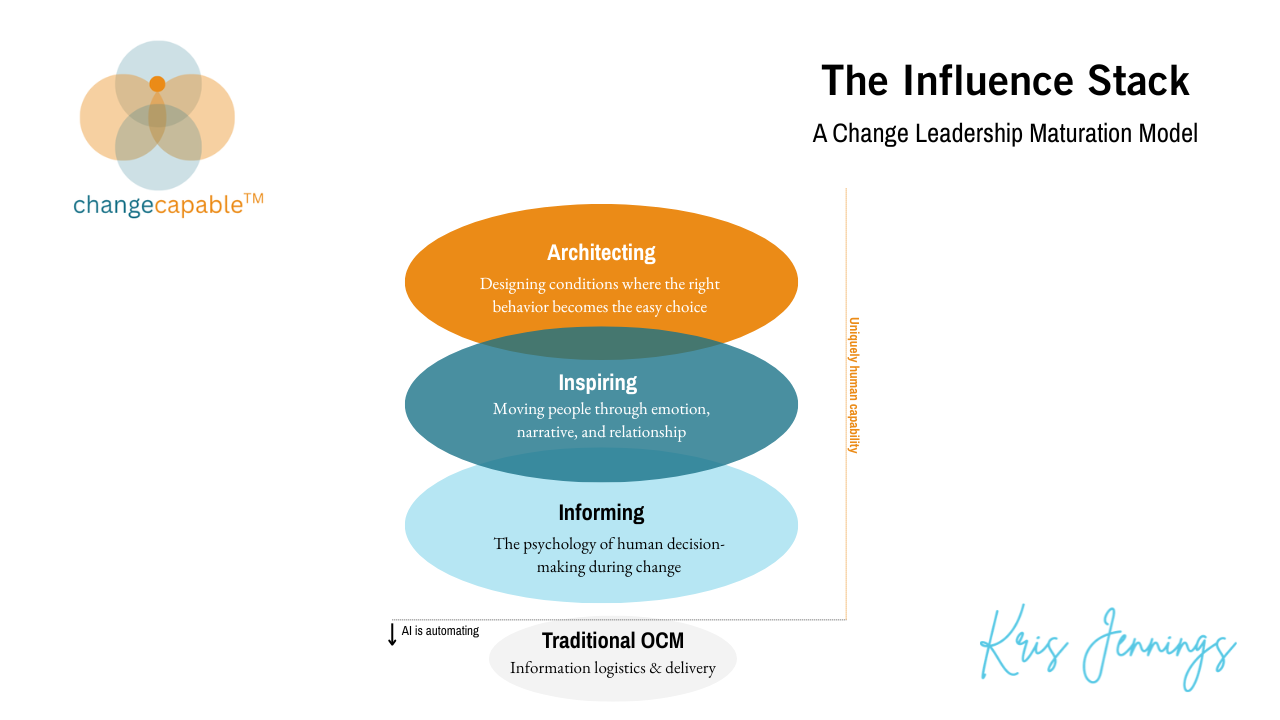
The Influence Stack describes three modes through which leaders influence behavior change: Informing, Inspiring, and Architecting. These aren't tactics you cycle through or steps in a process. They're a maturation sequence: a map of how change leadership capability actually develops over time, and a diagnostic for where a leader currently operates.
Most leaders begin, and many remain, in the first mode. The best leaders eventually reach the third. The journey between them is not linear, and it's not guaranteed.
Mode One: Informing
The Informing mode is not what most people think it is, and it is emphatically not what traditional change management does.
Traditional OCM's version of "informing" is tactical activities and logistics: who gets the message, through which channel, how many times, with what reviews involved. That work is being automated. What remains, what the Informing mode actually requires, is something that AI cannot do: understanding the psychology of human decision-making during change.
People don't receive information neutrally. They filter it through a set of cognitive mechanisms that have nothing to do with the quality of the communication.
Loss aversion: people experience what they're giving up as roughly twice as painful as what they're gaining, which means a logically sound business case for a change can still produce fierce resistance if it doesn't acknowledge the losses explicitly.
Present bias: people systematically overvalue immediate costs relative to future benefits, which is why well-reasoned visions of the future state rarely produce early adoption.
Status quo bias, framing effects, and reactance: each of these operates independently of how clearly the change is explained.
A leader in the Informing mode understands these mechanisms specifically. They don't just communicate more clearly. They design their change strategy to work with human decision-making rather than against it. They know which biases are most active for which groups. They anticipate that the message won't land the way they intended, and they diagnose why before the next all-hands rather than after.
This is already a significant advance beyond where traditional OCM operates. And it is only the first mode.
Mode Two: Inspiring
The leaders who break out of the Informing mode do so through a willingness to work with the parts of change that make analytical leaders deeply uncomfortable: emotion.
A leader in the Inspiring mode understands something that changes everything: behavior change is emotional before it is rational. Emotions influence behavior.
Resistance isn't a communication failure. It's a signal. Grief, fear, anger, and anxiety aren't obstacles to manage around; they're data about what people need from this change and from the leader leading it. My book, Inspired by Fear: Becoming a Courageous Change Leader, describes how a leader shifts from Informing to Inspiring.
Inspiring draws from emotional intelligence, from narrative design, from the behavioral science of how humans actually make meaning during uncertainty. The leader in this mode doesn't just explain the change. They tell a story about it. They acknowledge what's being left behind, not just what's being gained. They make people feel seen and remain connected in belonging to the group during the disruption, not just informed about the destination.
This is where I draw heavily from behavioral science, positive psychology, and psychological safety, not in a soft, feel-good sense, but in the rigorous sense of understanding which emotions are present, what they're signaling, and how to respond rather than react. Fear requires a different response than anger. Grief requires a different acknowledgment than anxiety.
A leader who can recognize emotional distinctions and who engages with emotion as data rather than noise is operating at a fundamentally different level.
Inspiring is also where the challenge of influencing without authority becomes central. Many change leaders don't have a direct reporting line to the people whose behavior needs to shift. They lead laterally, upward, and across functions, which means positional power is not available to them.
The leaders most effective here have developed influence through liking, reciprocity, and shared identity: Robert Cialdini's principles applied not as tactics but as a consistent relational posture.
They invest in relationships before they need them.
They give before they ask.
They make the change feel like something people are navigating together, not something being done to them.
They have engaged strategically with others who will help them lead and model the new behaviors (Athena, Cera Day's trusted business change lead, is a character in the book who shows how to operationalize this relational approach strategically and systematically).
That relational foundation is what makes people want to move. It's the one thing AI will never be able to build.
Many leaders reach this mode after a career's worth of hard lessons. Some never get comfortable here at all. The leaders who do, and who integrate it with their analytical capability, become significantly more effective. But there's still a third mode, and it's where the work gets genuinely sophisticated.
Mode Three: Architecting
The leaders I find most effective (and rewarding to work alongside) are the ones who no longer see behavior change primarily as a communication challenge or even an emotional challenge. They see it as a design challenge.
A leader in Architecting mode applies behavioral science and choice architecture to the change itself. They ask not just "How do I convince people to change?" but "How do I design the environment so that the right behavior becomes the natural, easy, default choice?"
This is the work of nudge design: creating specific, evidence-based interventions that make desired behaviors easier without mandates or directives.
It's the work of default redesign: asking whether the current systems, workflows, and decision environments are structured to support the change or quietly work against it.
It's the work of habit formation: understanding that adoption is not the same as sustained behavior change, and designing for the point at which the new way of working becomes automatic.
One of the most underused tools in Architecting is reward and recognition, applied not as a morale initiative but as a behavioral wiring strategy. Behavioral science is clear: behaviors that are recognized immediately and specifically after they occur are significantly more likely to be repeated and retained.
In a change context, this means a leader in Architecting mode isn't just celebrating wins. They're strategically reinforcing the exact new behaviors they need to become habitual, at the exact moment when those behaviors are most fragile. Recognition, applied this way, accelerates the neurological wiring of new habits and compresses the adoption curve. (This applies to the leaders themselves as they're building new change leadership behaviors!)
Leaders who operate in Architecting mode aren't just influencing people. They're engineering the conditions in which change happens.
This is the rarest mode. It requires behavioral science literacy, systems thinking, and the patience to design for long-term habit formation rather than short-term compliance. It's also where the most sustainable, high-adoption change outcomes come from, including, and especially, AI adoption.
You cannot explain an organization into a new relationship with AI. You can design for it.
Where are you on The Influence Stack?
The Influence Stack is a developmental tool, not a judgment. Almost every leader operates primarily in one mode, and the goal is not to abandon the earlier modes but to add to them.
A leader who has developed the Informing mode has real capability: understanding why change communications fail, reading the cognitive mechanisms at play in resistance, designing strategy around how people actually make decisions.
That capability doesn't disappear when they grow into Inspiring. It becomes more powerful because it's paired with emotional intelligence and narrative skill.
When Architecting is added, the ability to design the behavioral conditions for change itself, the result is a leader who can lead not just this change, but any change.
The useful question isn't "Am I in the right mode?" It's: "Which mode am I defaulting to when change stalls, and is it the one this moment actually requires?"
If the default is the logistics layer in the form of more "stuff": a better communication plan, another all-hands, a more thorough training calendar, it's worth pausing. AI can now produce all of that in an afternoon. If that was where the leverage was, adoption rates would be much higher than they are.
The leverage is in the modes that AI cannot touch.
Understanding the specific psychology of why this group of people, in this organization, is not moving yet. Moving people through the emotion and uncertainty of real change with presence, story, and genuine human connection. Designing the environment so that the new behavior becomes the path of least resistance rather than a daily act of will.
That's where the Influence Stack lives. In an era where every organization is navigating change faster than its people can absorb it, developing the full stack is no longer optional for leaders who want to lead well. And organizations need to strategically develop talent in their pipeline to mature this skillset.
That's not a soft observation. It's the hard one. It's where the most important leadership development work now begins.
Kris Jennings is an organizational change expert and author of Inspired by Fear: Becoming a Courageous Change Leader. Her changecapable™method applies behavioral science to help leaders drive adoption and sustain new ways of working. The changecapable™ Leadership Program, her signature group cohort, builds the full Influence Stack in 16 weeks, applied to a real change each leader is navigating.
Learn more about the program.
