
Why employees aren't using your AI tools
Jun 11, 2026You're missing a behavioral goal
A few months ago, I had an interesting conversation with a client in response to my question: "How is your organization approaching AI adoption?"
They had done everything "right". Copilot was live inside their Microsoft suite, the tools their people use every day. They held a training session. They emailed employees to promote it.
"Honestly?" she said. "Most people are still doing things the exact same way."
My follow-up question: "What does adopted look like for you?"
There was a pause.
"I mean... they're using it."
"What are they using it for? Which team? Which task?"
Another pause. Longer this time.
That pause is where most AI rollouts quietly fail. Well, honestly, it's where most technology rollouts of any kind fail.
Not in the functionality of the technology itself. Or the fact that the organization offered up change management support in the form of communications and training.
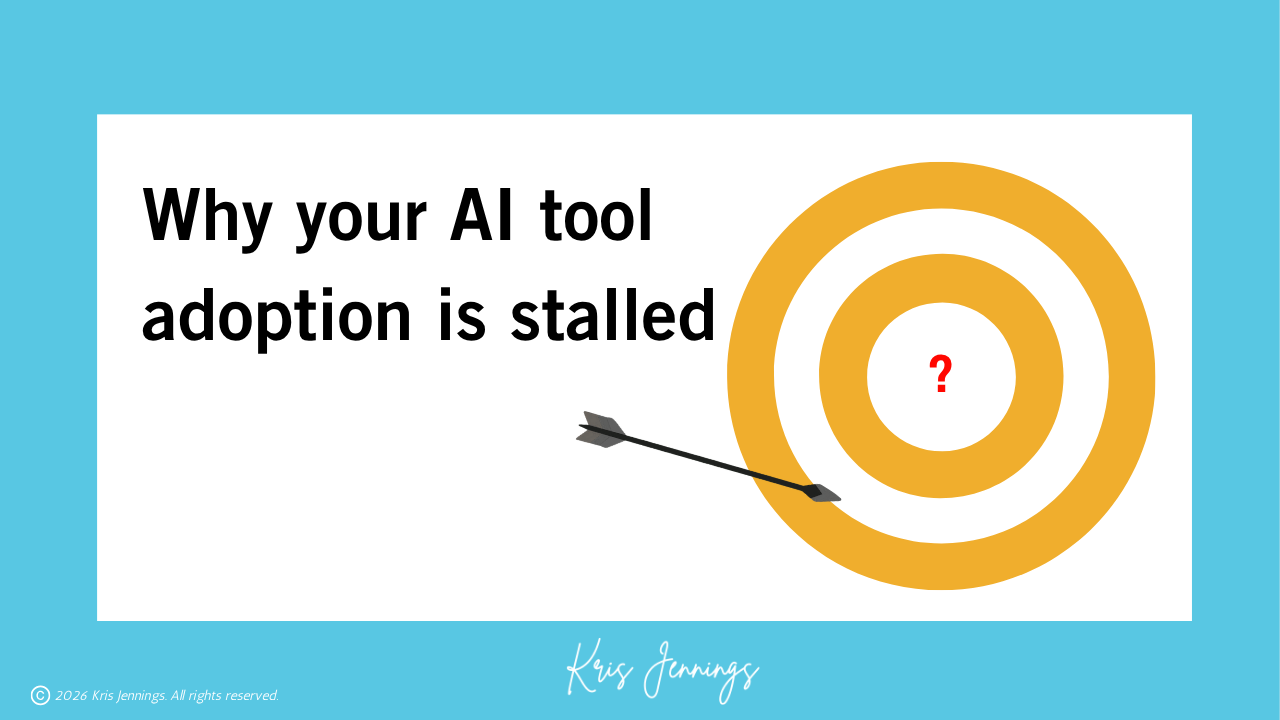
It fails because no one has specifically named what behavioral success looks like. It's a target without a bullseye.
The awareness trap
When organizations frame adoption as an awareness challenge, they solve it with information: training sessions, how-to guides, FAQ documents, emails, and mentions in town halls. If everyone were aligned and emotionally ready, these logic-based techniques would work.
Behavioral science has been telling us for decades that knowing what to do and doing it are two very different things. Your employees know the AI feature exists. Most of them have probably tried it once, maybe twice. But trying is not adopting. Awareness is not behavior.
What drives sustained behavior change isn't more information. It's the design of the environment around the behavior, and you cannot design an environment around a behavior you haven't defined.
The behavioral goal gap
Here's what makes this harder than it sounds. For many organizations right now, AI isn't even arriving as a new tool. It's a feature inside something people already use. Copilot in Word. AI summarization or a chatbot in the ERP. Suggested responses in the collaboration platform. The tool didn't change. A capability appeared inside it.
That should make adoption easier. Instead, it often makes the goal fuzzier. There's no "go live" moment, no ribbon cutting, no clear before-and-after. The feature just exists, so the question of what "using it" actually means gets skipped.
"Use the AI feature" is a category, not a goal. Use it for what? Instead of what? How often? By whom? To what end?
Behavioral science is unambiguous on this: vague intentions produce vague behavior. The more specific and concrete the target behavior, the higher the likelihood it becomes a habit. This isn't theory. It's how human cognition works. We move toward clear targets and stall in front of open fields. There is no clear "choice" to make.
There is a reason this gap is so common right now. Leaders are watching the AI tool landscape shift month to month, and many are making a quiet, reasonable-sounding bet: wait for the market to stabilize before committing to a specific platform or workflow.
In the meantime, they default to whatever capability already sits inside their existing software licenses, Copilot, an ERP feature, a collaboration tool plugin, because it requires no new decision.
That instinct has a name. It is the original meaning of FOBO: fear of better options. The fear of committing to one approach when a better one might be six months away. It is a rational response to a genuinely volatile market.
But this fear carries a cost. By defaulting to an existing tool, leaders skip the decision about what behavior adoption looks like.
Picture two different rollouts of the same AI tool.
One leader says: 'We want client-facing teams to draft their meeting summaries using Copilot before circulating notes, so the notes go out faster and reps spend less time on follow-up busywork.'
That's a deliberate choice, resulting in a specific task, team, and behavior to watch for.
The other leader says: 'Copilot's already inside our Microsoft suite, so let's just turn it on and see what happens.'
No one decided what it was for, so no one is on the hook to define what success looks like (or concrete ways to improve it when adoption falters).
What a behavioral goal actually looks like
"Draft meeting summaries using Copilot before circulating notes" is a behavioral goal.
"Leverage AI capabilities across the organization" is not.
The difference isn't just specificity. It's that the first one is designable. You can reduce friction around it. You can create social proof for it. You can measure it. You can build psychological safety around trying it and failing at it.
A behavioral goal names the person, the task, the tool, and the moment. It answers: What will someone do differently on Tuesday at 2 p.m. because of this rollout?
Before you spend another dollar on adoption support, get that specific. Pick one workflow. One role. One task. Define what doing it with AI looks like versus without. That is your behavioral goal, and everything else flows from it.
Before you roll out more AI features, ask yourself this question
Picture someone asking you right now, not "are your people using AI?" but "What behavior are you designing for?" What would you say?
If the answer is clear, specific, and role-based, you're in good shape. If it isn't, that's the work. Not more training. Not better communication. Defining the behavior.
Adoption doesn't happen because a tool is good. It happens because the behavior is designed for. That's the discipline and the opportunity in front of every technology change leader right now.
In the next post, what your people are actually feeling about your AI rollout, and why those feelings are more predictable than you think.
Change leaders learn how to apply these principles to a specific situation they're in right now (including AI adoption) through The changecapable Leadership Program ➡️
