
How to talk about emotions at work: The 3N influencing technique for change leaders
Nov 20, 2024Why naming emotions accelerates change adoption and builds psychological safety
Any parent knows two truths about children and emotions:
-
Young children express their feelings as they experience them. (i.e. a toddler who wants a treat and doesn't get it will show anger and sadness, regardless of where they are. But they always tire themselves out 😉).
-
The words associated with those strong sensations have to be taught. A child learns how to talk (or not) about these experiences from caregivers. Emotional concepts and words are highly culturally and environmentally contextual. The words I use for how it feels to fall off my bike are likely different than the ones you learned, depending on what we were taught. They are unique to the individual, as neuroscientist Lisa Feldman Barrett shares in her book How Emotions are Made.
Why we stop talking about emotions at work
After the early years, when emotions are felt and expressed as they occur, humans begin to apply socialization norms. Through interaction with others at school, play, and eventually, work, we learn the "rules" of emotions. What we are or aren't supposed to feel or say about our feelings. When we are—or aren't—supposed to talk about them.
In Western culture, some emotions are more accepted socially than others. Anger and joy are celebrated and shared, but sadness and fear are things we learn to hide.
Research shows this emotional suppression has consequences. A 2023 study published in the Journal of Applied Psychology found that employees who suppress emotions at work experience higher burnout, lower job satisfaction, and reduced team trust.
That's a problem for organizational change, as fear and sadness are necessary to let go of what was and accept what will be. As psychiatrist Elizabeth Kubler-Ross identified more than 50 years ago, the change curve is a natural part of the grieving process.
What change leaders can do about emotions
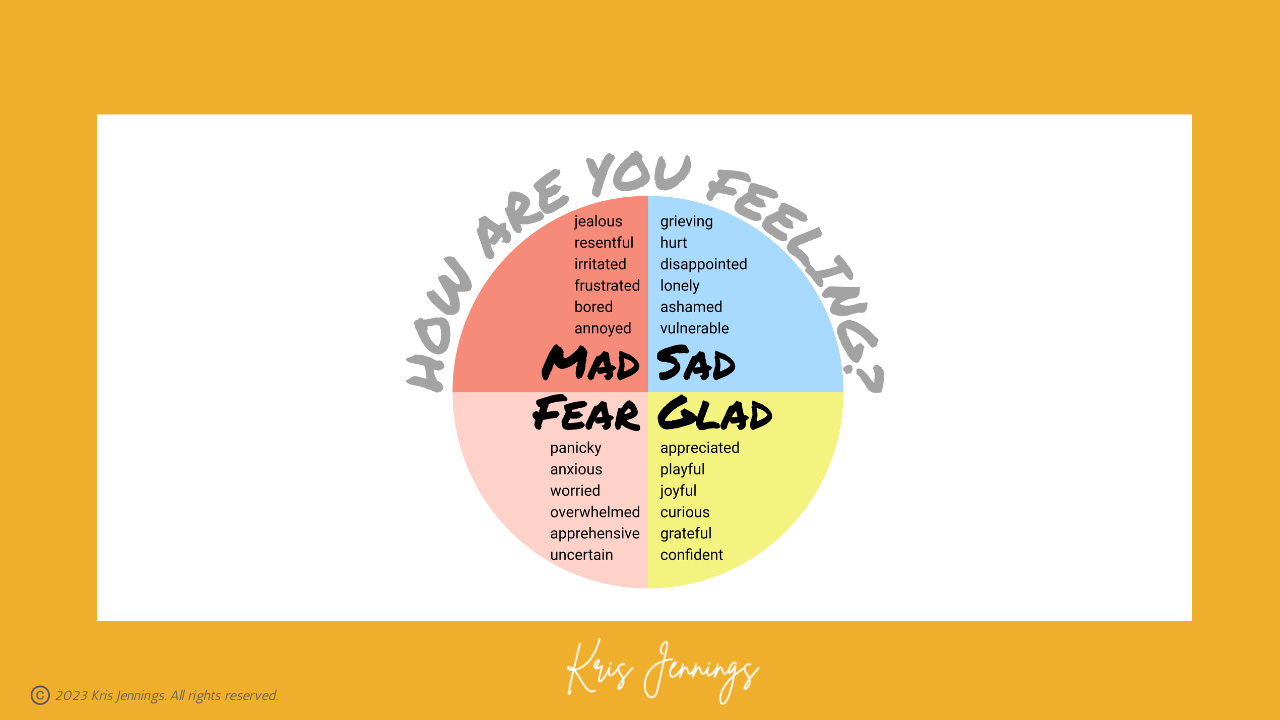
The good news is that this is relatively easy to address. Change leaders can provide the words and model how to talk about emotions using a simplified version of the Emotion Wheel by American psychologist Dr. Robert Plutchik. Through all of my years working with organizations in change, this condensed version is easier to remember with just four emotional categories:
- Fear
- Mad
- Sad
- Glad
Within these emotional categories, there are other words to describe varying intensity levels. For example, in the emotional category of fear:
- Panicky
- Anxious
- Worried
- Overwhelmed
- Apprehensive
- Uncertain
All of these are forms of fear, and describe different states of intensity and arousal (feeling panicky is generally more activating and uncomfortable than feeling apprehensive).
Note that these are just some words people may use to describe feelings. For the change leader, this isn't an exercise in precision. It's not about expecting individuals to learn how to use the "right" word.
The power of naming emotions
Rather, by asking, "How are you feeling?", the change leader gives the individual a chance to name it. This is empowering, and allowing the emotion to be noticed and named generally allows it to subside within 90 seconds, which is the normal cycle for an emotional experience, according to neuroanatomist Dr. Jill Bolte Taylor. (Think back to your toddler days and how quickly most emotions subside).
Neuroscience research supports this practice. A UCLA study on "affect labeling" found that putting feelings into words reduces activity in the amygdala (the brain's emotional center) and increases activity in the prefrontal cortex (the rational thinking center). In other words, naming emotions literally helps us think more clearly.
For the change leader, noticing and naming the category as shared by whatever word used goes a long way to validating the individual. Words a change leader can use to do this:
"I hear you describing fear. Is that accurate?"
Imagine the relief the individual feels by being understood in that moment! It is an effective way to strengthen relationships and build loyalty and trust.
From emotion to action: The Nudge
Once the emotion subsides, the change leader can gently nudge the individual into action.
"Now that your fear has subsided, what would you like to do about it? How can I support you to learn more?"
The change leadership skill of Noticing, Naming, and Nudging emotions into action is called the 3N Influencing Technique. Change leaders who master recognizing emotions in the moment help accelerate change adoption and prevent change resistance. People are less likely to get stuck in a repetitive anger cycle, or become frozen and incapable of learning if they can't resolve a fear cycle.
Building psychological safety through emotional intelligence
Change leaders who consistently model how to notice and name their emotions help create a psychologically safe culture. This leads to stronger collaboration and problem-solving in teams.
According to Google's Project Aristotle research, psychological safety—the belief that you can speak up without fear of punishment or humiliation—is the #1 predictor of high-performing teams.
How we feel influences what we do, and when people recognize and own their emotional experience, they help themselves to address what they need to move forward. That empowering feeling helps them feel good about change.
Take the next step: Bring this message to your organization
Help your team shift from reacting to change to responding with clarity and courage
Book a keynote to equip your team with the emotional intelligence skills to navigate uncertainty and lead change with courage. Your team will learn to recognize fear responses, apply the 3N Influencing Technique, and build psychological safety during change. Learn more about keynote speaking services.
For leaders who want deeper exploration, read my book Inspired by Fear: Becoming a Courageous Change Leader, where I show how to handle specific examples of influencing up, across, and down using the 3N Influencing Technique. Buy the book.
Updated April 1, 2026, to include current research and resources.
